

Article: Hall, stairwell, and landing: the forgotten reverberation spots in your home
Hall, stairwell, and landing: the forgotten reverberation spots in your home

A hallway, stairwell or void is almost always the space that reverberates the most in the house, and almost always the space nobody thinks of when it comes to acoustics. That makes sense: you only pass through briefly, so you get used to the sound. But it is precisely this tall, narrow space with bare walls and a hard floor that makes every sound bounce back multiple times. A door slamming shut, footsteps on the stairs, a conversation you can still hear two floors away. An acoustic artwork dampens that sound right where it lingers the longest.
Why does a hallway, stairwell or void reverberate so much more than other rooms?
The short answer: height and hard surfaces. In a living room there is a sofa, cushions, perhaps a curtain. These already absorb part of the sound. In a hallway or near an open staircase, there is virtually nothing to catch the sound. The walls are bare, the floor is hard (tiles, concrete, wood), and the ceiling is often metres higher than normal. Sound travels upward, bounces off the ceiling, and returns without meeting anything along the way. The taller the space, the longer the reverberation persists.
With a void there is an additional factor: the space is open to another floor. Sound from below rises and mixes with sound from above. The result is a kind of acoustic funnel: everything sounds louder than it is, and it lingers longer than you would expect.
What do you notice in practice?
The most common example: you are on a call in the hallway and the person on the other end asks whether you are standing in a church. Or your children are playing upstairs, and downstairs it sounds as if they are right next to you. In an open stairwell you hear every footstep on every floor. It is not necessarily loud, but it is restless, and it never stops. With a void or high ceiling the effect is even stronger: an ordinary conversation at the dining table suddenly reverberates through the entire house.
Why does everyone forget about the hallway and the stairwell?
Because you do not sit there. The living room, the kitchen, the office, those are the places where you actively look at acoustics. The hallway is just the space you walk through. But the sound that originates in the hallway does not stay in the hallway. It travels to the room next door, rises through the stairwell, spreads through the void. If you notice that your living room reverberates more than you would expect, the cause sometimes lies not in the living room itself, but in the open connection with the hallway or the staircase beside it.
How do you tackle reverberation in a hallway, stairwell or void?
The most effective approach is to place absorbing material where the sound lingers the longest, which is on the wall opposite the hardest surfaces. In a hallway that is usually the wall facing the front door or the window. In a stairwell it is the long wall alongside the stairs. In a void it is the wall that extends across multiple floors.
Which size works best depends on the space. In a wide hallway with a high ceiling, a large rectangular artwork (80x120 or 100x150 cm) has the strongest effect: you have the wall width, and a generous surface area absorbs the most sound. In a narrow stairwell where you have little width, a slim format (60x180 or 70x210 cm) is more practical: it makes use of the height without blocking the passage. And in a long hallway, you might also consider two or three smaller works spread along the wall, which distributes the absorption across the full length.
As for the damping level: with a high ceiling or an open void, Ultimate (100% absorption) is the most effective. The extra thickness of 7.2 cm is barely noticeable visually on a tall wall, but the difference in absorption is clearly audible. If you have a lower hallway (under 3 metres) with just a hard floor and bare walls, Extra (80%) is usually sufficient.
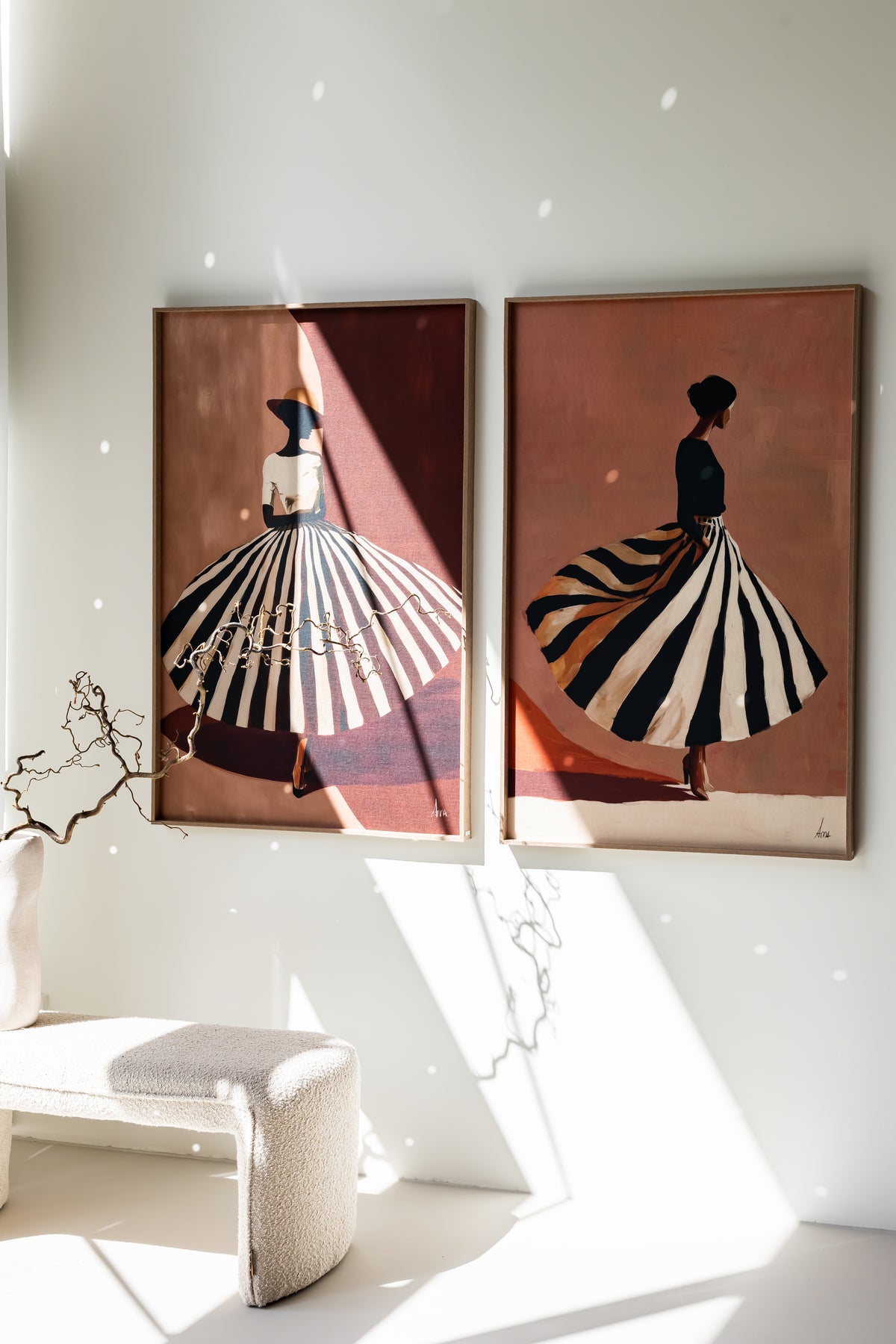
Two popular choices for these kinds of spaces: the Noé & Noah combi slim for narrow stairwell walls, and the bestsellers in the larger rectangular format for wider hallways. A combination of two works above or beside each other creates a calmer and more impactful visual effect than a single piece, and increases the total absorbing surface.

Can I see what it looks like in my space first?
Yes. Order a sample to lay the colour and material next to your wall at home. The amount is refunded when you place your order. Would you rather have us take a look? Send us a photo of your hallway, stairwell or void, and we will be happy to advise on the right size and best position, free of obligation. We do this regularly, precisely because these kinds of spaces are harder to judge than a straight wall above the sofa.
Curious which works suit your space best? Browse the bestsellers for the most popular choices, or the slim collection if you are specifically looking to treat a narrow stairwell.
Frequently asked questions about reverberation in hallways, stairwells and voids
Why does my hallway reverberate so badly?
A hallway is usually narrow, tall and bare: tiled floor, no textiles, few furnishings. Sound bounces back and forth with nothing to absorb it. The higher the ceiling, the longer the reverberation persists.
Does one artwork in a stairwell help against reverberation?
Yes, noticeably. One large work (or a slim combination) on the wall alongside the stairs catches the sound right where it lingers the longest. For an open void spanning multiple floors, a second work on another level can strengthen the effect.
What size works best in a stairwell or hallway?
That depends on the available wall width. In a wide hallway, a large rectangular artwork (80x120 or larger) has the strongest effect. In a narrow stairwell, a slim format (60x180 to 80x240 cm) is more practical because it uses the height without blocking the passage. In a long hallway, you can also spread two or three works for more absorption across the full length.
What damping level do I need with a high ceiling?
For a ceiling above 3 metres we recommend Extra (80%) or Ultimate (100%). The extra thickness is barely noticeable visually on a tall wall, but the difference in sound absorption is clearly audible.
Will an acoustic artwork make my hallway completely silent?
No, and we do not promise that either. It noticeably dampens the reverberation, making conversations sound clearer and sounds linger less. To make a hallway fully silent you would need to treat all hard surfaces, and in practice that is rarely necessary or desirable.